Aegean Sun Fruit
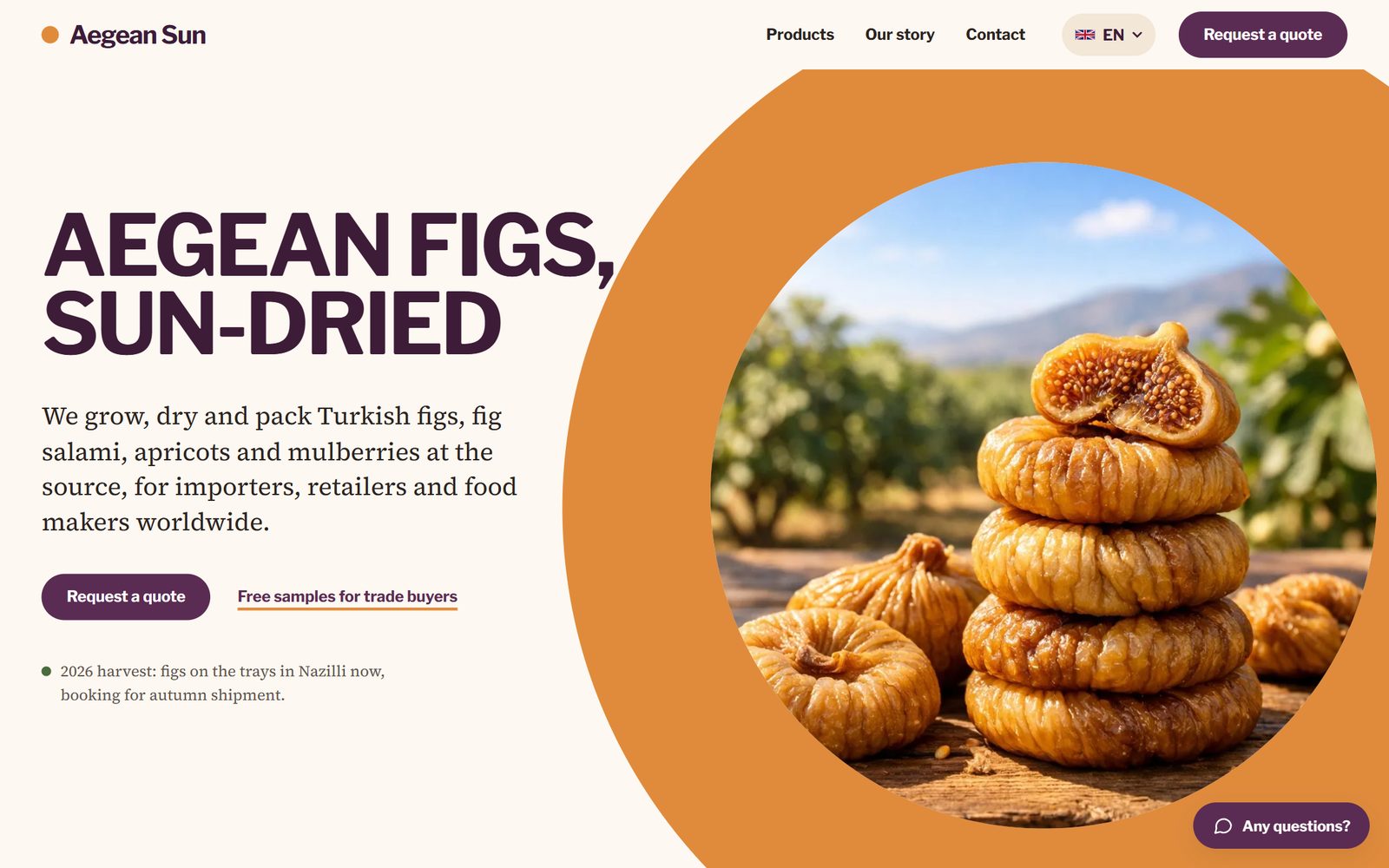
A bilingual English and Turkish website I developed for an independent dried-fruit trading business, built to present its range to trade buyers and collect enquiries.
Website / digital experience · Personally developed
- Status
- LiveThe website answered at www.aegeansunfruit.com when I checked it on 25 October 2026. The business, its products and every fact published about them belong to the client.
- My role
- I developed the website: the page structure, the bilingual setup, the front-end code, the enquiry and newsletter forms, consent-gated analytics and the files that help search engines and AI assistants read it.
- Operated by
- The dried-fruit trading business is owned and operated independently by the client. I developed the website only and do not sell its products.
- Last verified
Visit the website (independent business) (opens in a new tab)
In plain words
- What it is
- A marketing website, in English and Turkish, for a business that sells dried fruit to trade buyers. It presents the product range, specifications and trade terms, and offers forms for price and sample enquiries.
- Who it is for
- Importers, distributors and other trade buyers who want to check a range, its grades and the terms before they ask for a quote.
- The problem it addresses
- Trade buyers need detail quickly, in their own language, and one obvious way to ask for a price. The site turns a dense catalogue into readable pages that all lead to an enquiry.
A dense catalogue, two languages
Dried-fruit trade runs on detail: varieties, grades, calibres, pack formats and shipping terms. Buyers compare several suppliers and often read in a second language. The client needed that detail presented in English and Turkish without burying it, with every page leading toward one action, sending an enquiry. The site also had to be cheap to host and easy to change without a developer on call.
Privacy was the second constraint. Many visitors are likely to be in the EU, so analytics could not load before a visitor agreed, and the privacy page had to describe what the site really does. The forms also had to work without a paid backend or a server that someone would need to maintain.
My role
I developed the website end to end in plain HTML, CSS and vanilla JavaScript: every page in both languages, the shared design tokens, the forms and their delivery to Google Forms, the consent bar, the rule-based sales assistant and the search files. The business content, product facts and photography come from the client, who approves them.
What was built
The site pairs every English page with a Turkish one: a home page, a products overview, four product pages, about, contact and a privacy notice. Each page leads to an enquiry, and the supporting pieces (consent, analytics, auto-replies, the assistant) were built so the client can run them without a developer.
Paired bilingual pages
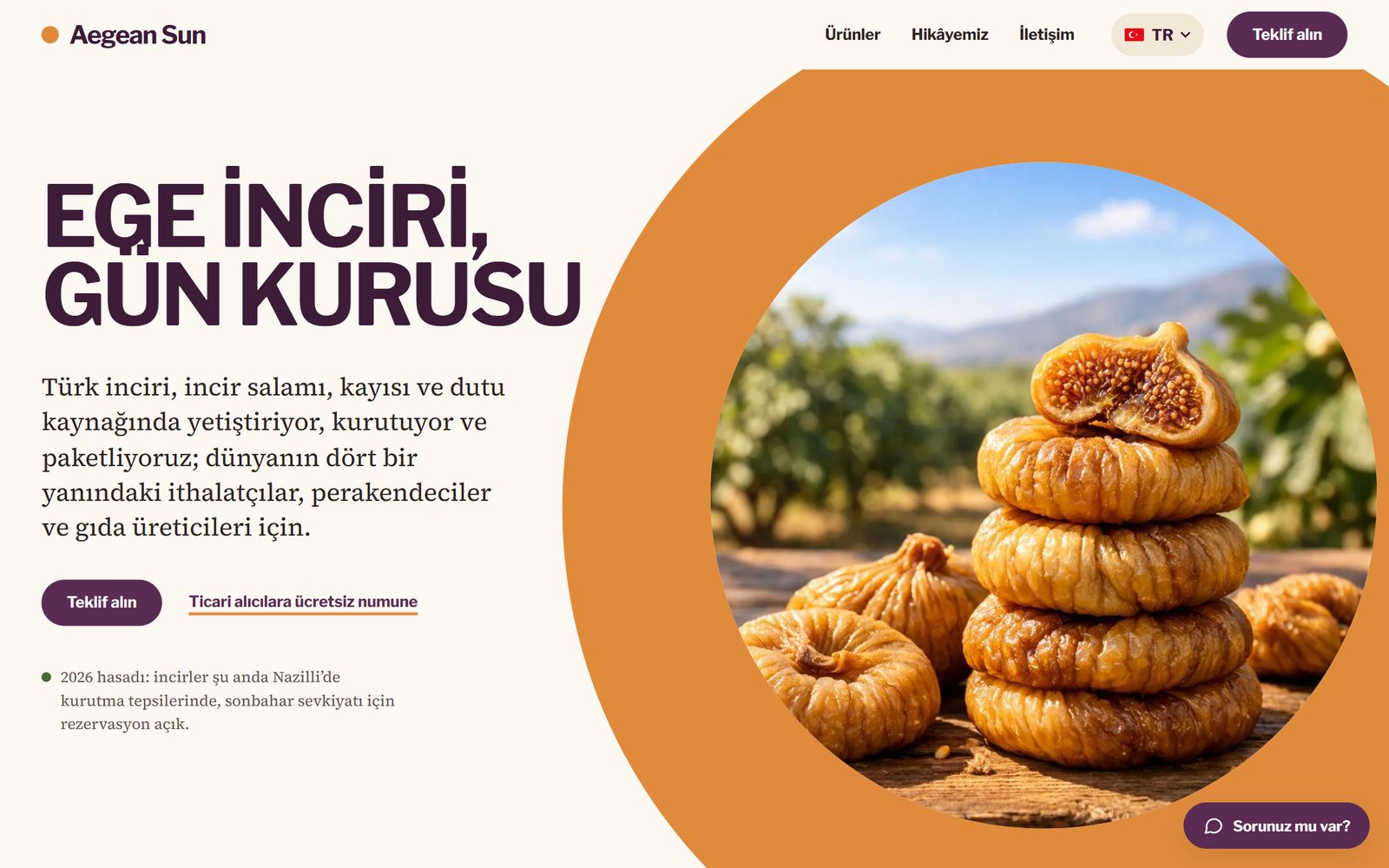
ShippedEach English page has a Turkish counterpart with its own slug. The language switcher opens the same page in the other language, not the home page.
Product catalogue
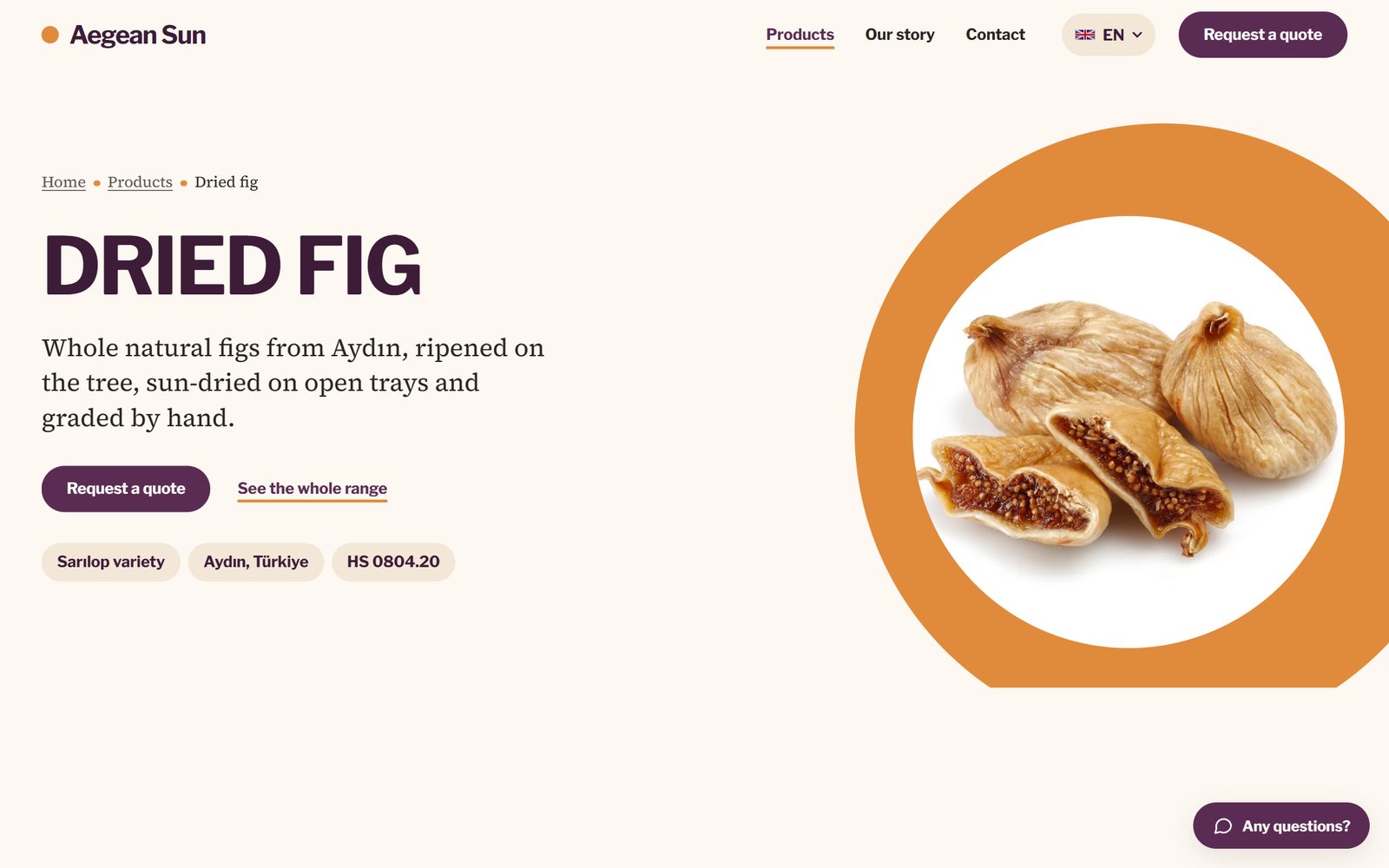
ShippedA products overview with a comparison table and one page per product with specification, grades, packaging and uses.
Enquiry forms
ShippedA carton-label enquiry on the home pages and a full enquiry form on the contact pages, validated in the browser and delivered to the client's Google Forms.
Newsletter with double opt-in
ShippedA sign-up form backed by a Google Apps Script that sends a confirmation link, a welcome e-mail and a working unsubscribe link. It runs once the form owner completes a one-time setup.
Consent-gated analytics
ShippedA cookie bar where Decline is as prominent as Accept. Google Tag Manager and Analytics load only after Accept; a cookieless Vercel counter runs separately.
Rule-based sales assistant
ShippedA small chat widget with no backend that matches keywords and answers only with facts already published on the site, in the page's language.
Search and AI readiness
ShippedAbsolute canonicals, hreflang pairs with x-default, a sitemap with language alternates, JSON-LD on the home pages, robots.txt naming AI crawlers, and an llms.txt summary.
How it works
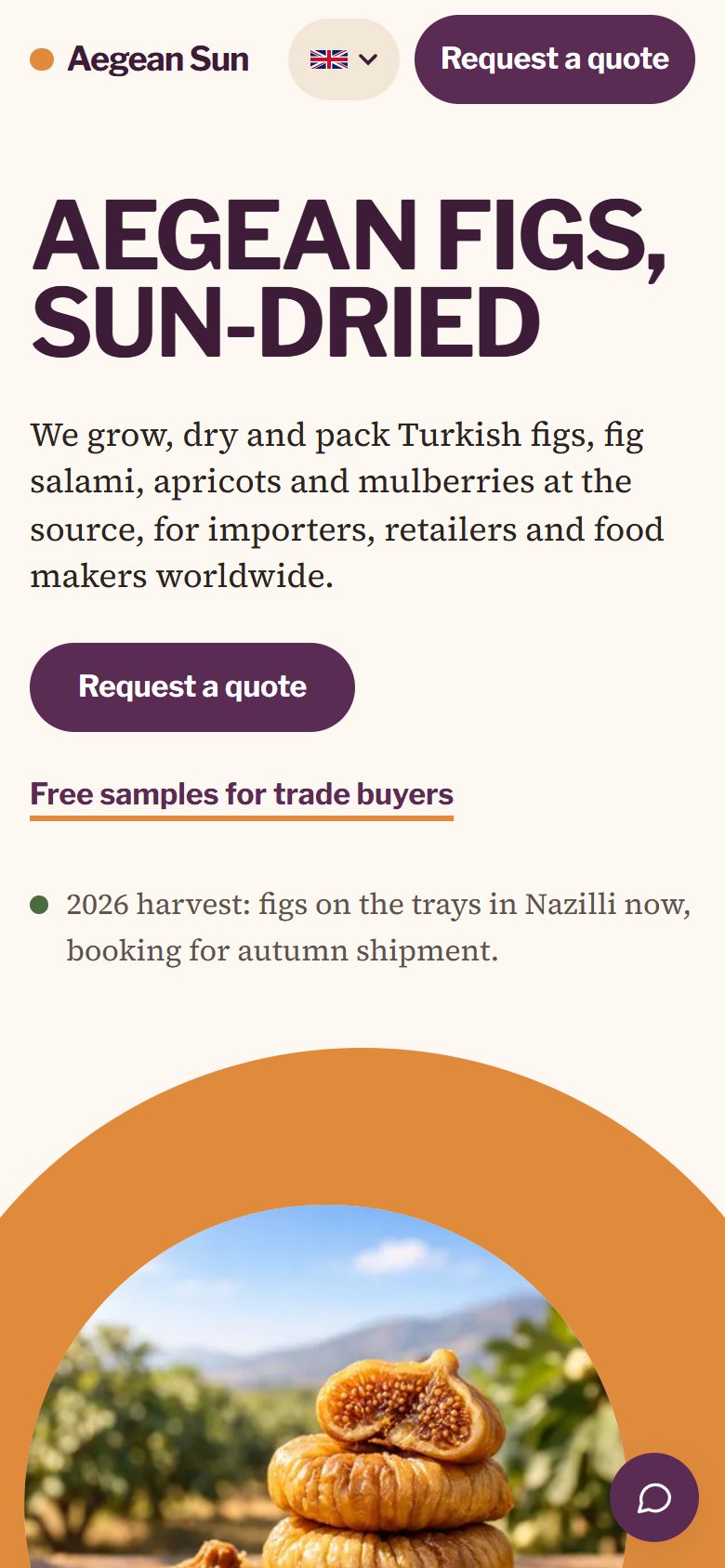
The site is static: no framework, no build step and no dependencies. Every page is a complete HTML file with its own header, navigation and meta tags, and all pages share one stylesheet built on design tokens. The page's lang attribute decides the language of every script, so the form messages, the consent bar and the assistant answer in English or Turkish without per-page settings.
A form is checked in the browser first: invalid fields are marked for screen readers and the first one takes focus. The values then go to a Google Form. A hidden honeypot field and a minimum time on the page filter simple spam. If the request fails, the visitor is offered a pre-filled e-mail instead. A Google Apps Script sends each sender a reply in their language.
Running it day to day
Enquiries arrive in the Google Forms response sheets, and the client can switch on e-mail notifications. Auto-replies are capped per day so the public forms cannot be used to exhaust the mail quota. A newsletter is written as a Gmail draft and sent by one script command, which never sends the same issue to a person twice.
The repository's README works as an operating manual. It explains how to add a page in both languages, how to change a form question without silently losing responses, and why a fact must be updated on the page, in llms.txt and in the assistant together.
Decisions behind it
The key choices are written down in the repository with their reasons. Consent mode stays basic rather than advanced, because advanced mode would contact Google before consent, break a promise on the privacy page and bring no modelled data at this traffic level. The assistant stays rule-based to avoid running costs and data leaks. Unverified business figures are marked as placeholders for the client rather than invented.
What it shows
The outputs are a live bilingual website, a documented design system and an operating manual that lets the client run forms, consent and newsletters without a developer. I do not publish visitor, enquiry or sales figures for this site, and none of the business claims on it are mine to confirm.
Technical, operational and managerial
Technical
The site is hand-written HTML and CSS with small scripts, hosted as static files. International SEO comes from paired pages, hreflang tags, absolute canonicals and a sitemap with alternates. JSON-LD describes the organisation, the product list and the film. Analytics loads only after consent.
Operational
Every page leads a trade buyer toward an enquiry. Enquiries land in Google Forms with an automatic reply in the sender's language, and newsletters follow a confirm-first, unsubscribe-anytime flow. Content changes follow one rule: update the fact everywhere it appears.
Managerial
The page structure follows how a buyer evaluates a supplier: range, specification, terms, contact. A recorded design system keeps the brand consistent. Decisions on consent, analytics and the assistant are documented with their trade-offs so the client can revisit them knowingly.
Questions answered
Does Gönenç Türkekul sell dried fruit?
No. The dried-fruit trading business is owned and operated independently by the client. I developed the website only.
How do search engines know which language to show?
Each English page and its Turkish counterpart point to each other with hreflang tags and absolute canonical URLs, and the sitemap lists both versions with an x-default. There is no automatic redirect by browser language; visitors switch by hand.
How do enquiries reach the business?
The forms send their answers to Google Forms owned by the client. The sender gets an automatic reply, and if the request fails the site offers a pre-filled e-mail instead.
Why plain HTML instead of a framework?
The site is small, mostly content and changes rarely. Static files are cheap to host, fast to load and easy to edit, and there is nothing to update or patch between changes.
Does the site track visitors before they agree?
No Google script loads before a visitor accepts the cookie bar. A cookieless Vercel counter records page views without a per-visitor identifier.
Are the product facts on the site verified by Gönenç?
No. The specifications, figures and company details are the client's content and the client's responsibility. My work covers how the site presents and delivers them.
Proof and links
- Live website (opens in a new tab)Independent business. Reachable when checked on 25 October 2026.
- Source codeThe repository is not linked publicly.
Related work
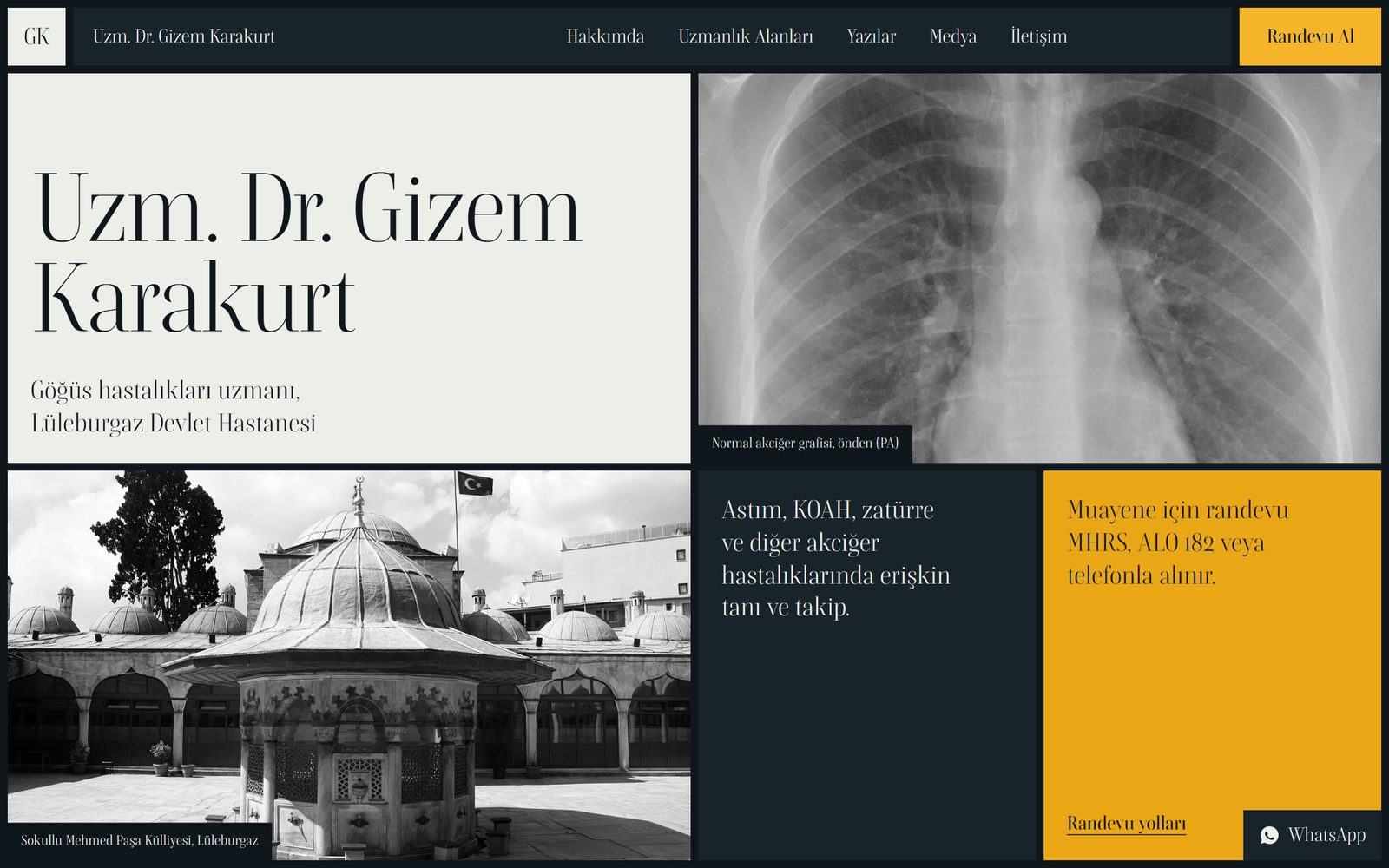 gizemkarakurt.comProduct or buildA Turkish-language website I developed for pulmonologist Uzm. Dr. Gizem Karakurt, with condition guides, articles, appointment guidance and privacy notices.Websites & Digital ExperiencesServiceFor firms and professionals who need a website that explains what they do, earns trust and is easy to find. Content architecture, UX direction and a responsive build scoped to the real audience.SEO/GEO-Ready Information ArchitectureServiceFor websites whose products or services are hard for people, search engines and AI answer tools to understand. Content inventory, page models, internal links and technical search foundations.
Need a site like this one?